In practising to create and use Wardley Maps, “what should I map?” is a common nagging question we encounter. Books or articles furnish us with material we can use to deal with it.
We get to practice mapping (the how) without worrying about the what to map.
This was a talk I gave at last year’s BarCamp. Slides are on Speakerdeck and the video on YouTube.
Why use books to practice
One way for us to practice Wardley Mapping is to map what's in a book or an article. I'm using "book" to mean all that we mentally consume that interests us. That could be books, articles, wikipedia, tweets, podcasts, zoom conversations, and so on.
So why practice in this way? I see three reasons.
- books provide material to map
- books give us a context we can share and therefore map with others
- books are an excellent guard against breaking NDAs
Must I practice? Nope. It's your life. You can do whatever you want. But I think your mapping improves faster the more you practice. There's no pressure to make the maps polished.
Books provide matter
The most important reason is that we don’t have to worry about that nagging feeling, asking ourselves, “what should I map?” or “I don’t have anything to map.” Books provide the material, “the matter,” and we give it “expression” - we express the matter as a map.
When we're learning to express something, the additional cumbersome job of finding that "something," should be removed so that we can concentrate on "expressing" it.
Alexander Bain realised this when teaching English Composition. He tells us,
The composition of Themes involves the burden of finding matter as well as language; . . . For an English exercise, the matter should in some way or other be supplied, and the pupil disciplined in giving it expression. . . . Another exercise is the conversion of Poetry into Prose. Much value is also attached to Abridging and Summarizing; and this might be coupled with the opposite practice of filing up and expanding brief sketches. - Preface to "English Composition and Rhetoric"
What do we get out of such practice?
Applying that to Wardley Mapping, "books" give us useful material.
What’s the equivalent of “Poetry” and “Prose” in Wardley mapping? Look at it is this way: “Poetry” (expressing much with little) corresponds to the drawn map whereas “Prose” corresponds to the stories, the narratives we tell that are based on those maps. These stories/explanations, being more acceptable, are published in public documents and reports. I've yet to see Wardley Maps in an official reports or announcements.
Molding Alexander Bain's observation to Wardley Mapping would look like this:
The creation of Wardley Maps involves the burden of finding matter as well as language;… For a mapping exercise, the matter should in some way or other be supplied, and the pupil disciplined in giving it expression. . . Another exercise is the conversion of Wardley Maps into Stories and of converting Stories (explanations/narratives) into Wardley Maps.
What do the examples look like? One example of moving between Maps and Stories is MXNet on AWS. At MapCamp 2017, Adrian Cockcroft walked us through this Wardley Map
I found these AWS MXNet announcements (made in 2017) that correspond to the components in the map with the numbers, (7) (5) (3) (1) respectively:
- Announcing the support of Gluon models
- Nvidia Volta
- Announcing the support of Keras2
- Incubation status of Apache MXNet
Another example is related to the NHS. Here, there's a "story" but not a map. If I know about someone there who also Wardley maps, then when I read their announcements, like this one, I sketch out what the Wardley Map would look like.
Yet another example are the series I'm writing about Gerstner and IBM.
Books give a shared context
Secondly, books give us a context we can share. We can use that as a basis of mapping together.
When I map with others from another industry, we spend time learning the basic terms and concepts of each industry so that we're able follow the map we're creating.
Reading a book (article/video/etc) that explains an industry helps us shorten the time we spend on such basics.
Books as a safeguard against violating NDAs
I like to map what I do. Publishing it is another story. I've written many a post about Wardley Maps within our company's firewall. What I liked about it the most was to write uninhibited. I know that those who read it, even if not working in my department, will have the same company context as I do. They can orient themselves around the terms we use, how we work, what I mean.
Writing in such an unrestrained way externally does not work as well for me. Like you, I'd like to honour what's confidential. How then shall I write about this interesting topic 'X' when it can be perceived that I'm revealing something I shouldn't?
Books to the rescue! There's a book for each topic. When I find those that are close to what I do, to what I find interesting, I'll map it out. Sometimes, I'll write about them. But I'll not map every book nor each section of a book.
An example is this conversation I had with Chris Daniel. We walked through a Wardley Map on Professional Services that's based on David Maister's book, Managing the Professional Services Firm.
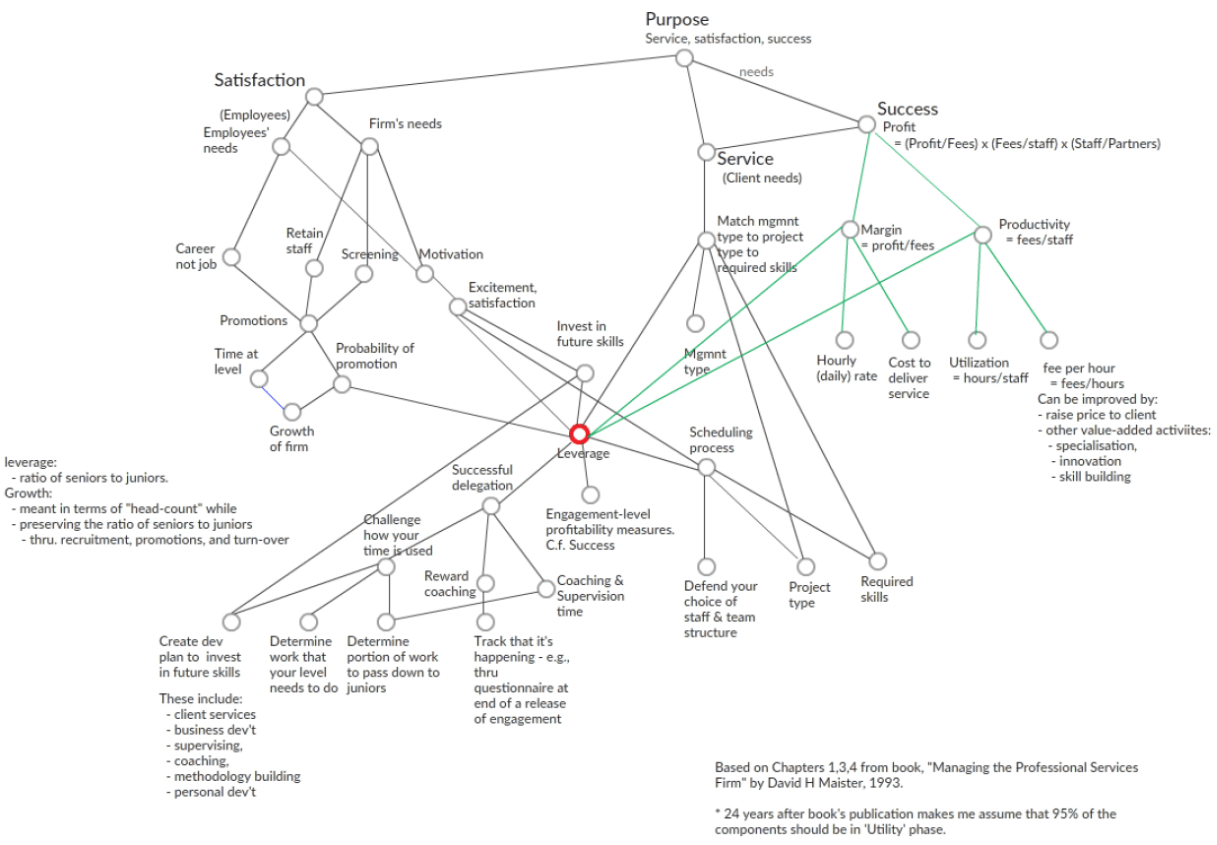
Is there a map for that?
Funny you should ask. Yes, there is a map for that - see step 4 and 3 from Cognitive Hierarchy are applicable.
One reason I prefer books is that, as a medium, they are a more evolved, even though the ideas they contain are spread out across the evolution X-axis.
Others as example
Others do it too.
I love the videos that Marcus Guest creates. Those prefixed "Second Opinion on . . ." walk through a Wardley Map based on articles from the Financial Times.
Another fascinating example was Ben Mosior's mapping of people's twitter profiles
Let’s not forget the Mapping Monday series from Cory Foy which he based on [April Dunford](https://twitter.com/aprildunford‘s book, Obviously Awesome.
Conclusion
What to map, the "matter", is in what we consume. We get to practice mapping (the how) without any more worries about searching for the what to map.
Happy mapping!